
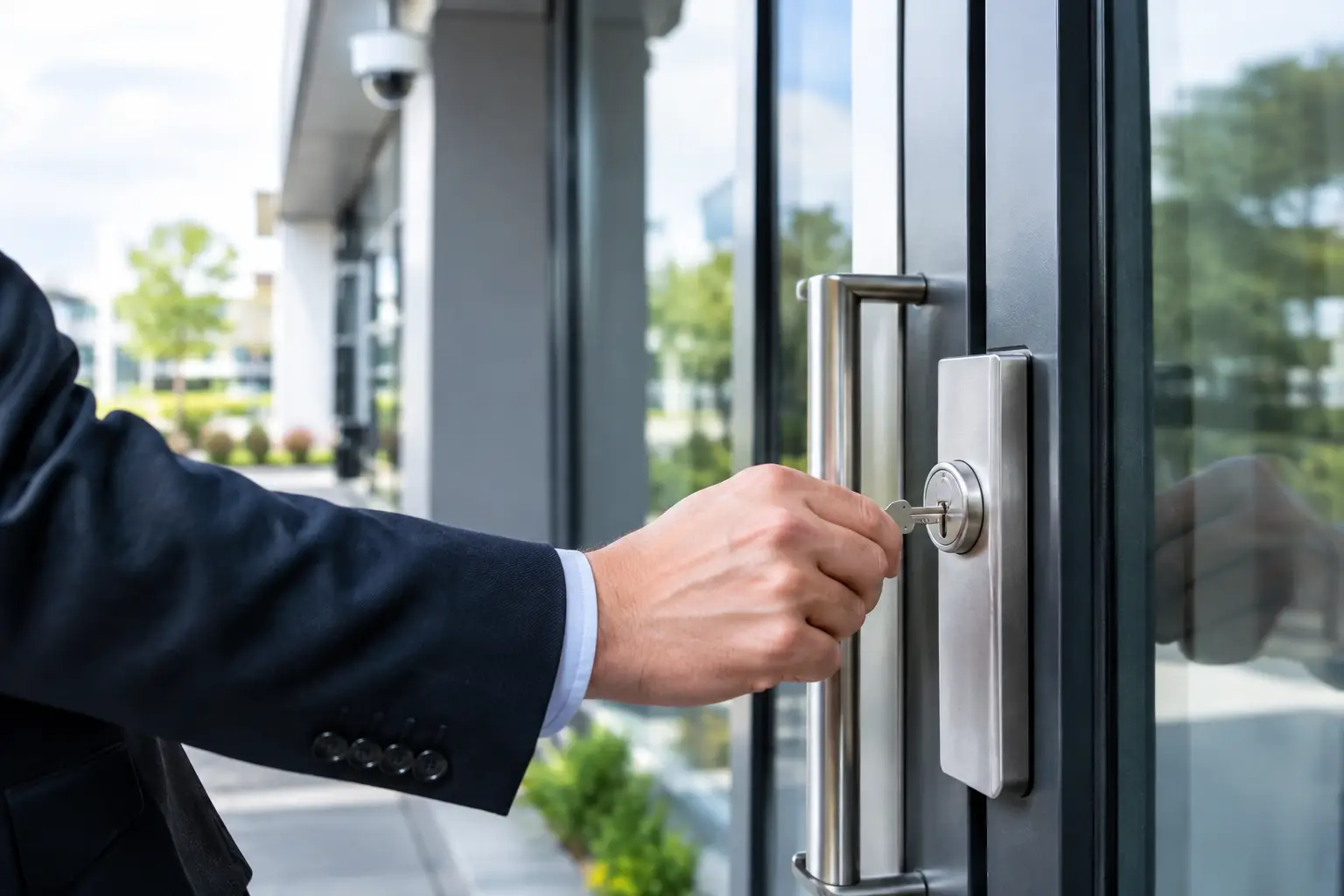
Commercial Lock Security Guide for Managed Sites
A commercial lock security guide is most useful before there is a break-in, staff key goes missing or a vacant unit needs securing at short notice. For landlords, managing agents and business owners, locks are not a minor finishing item. They control who can enter, protect stock and equipment, support safe evacuation and help keep a property ready for tenants, inspections or handover.
The right approach is rarely to fit the most expensive lock everywhere. A small office, a retail unit with high-value stock and a multi-let commercial building have different risks, access patterns and duties. The aim is to match the lock and access arrangement to the door, the people using it and the consequences if it fails.
Start with the building, not the lock
Before choosing replacement locks, assess each entrance and the way it is used. A rear service door may be more exposed than the front entrance. A shared corridor may need controlled access at all hours, while a plant room should only be available to named personnel. Doors left unsecured during deliveries, shift changes or contractor visits can create a greater risk than the cylinder itself.
Look at the door construction and frame as well. A quality lock fitted to a damaged timber frame, loose keep plate or poorly aligned door will not perform as intended. On aluminium, steel, timber and composite doors, the correct lock case, cylinder, handle and fixing arrangement all matter. Signs of rubbing, difficulty latching or a key that needs force are maintenance issues worth dealing with early.
It is also sensible to record who needs access to each area. Separate public, staff, tenant, contractor and management access where possible. This makes it easier to remove access when a tenancy ends or a member of staff leaves, without disrupting everyone else.
Choose security that suits the door’s purpose
Commercial premises commonly use euro cylinders, mortice locks, rim cylinders, multi-point locking systems and electronic access control. Each has a place, but they are not interchangeable.
A euro cylinder may be suitable for many uPVC, composite and aluminium doors, provided it is correctly sized and does not protrude excessively from the handle. The cylinder should be chosen with the door furniture and overall security of the entrance in mind. A multi-point door also relies on correct adjustment: if hooks, rollers or bolts do not engage fully, changing the cylinder alone will not resolve the weakness.
Traditional timber doors may use a mortice sashlock or deadlock. The lock should be matched to the door thickness, frame condition and the level of use. For a frequently used staff entrance, consider whether the arrangement allows people to leave easily without compromising security when the building is closed.
For common entrances, offices with regular staff changes or sites with multiple occupiers, electronic access can offer better control than widely copied mechanical keys. Fobs, cards, keypad codes and app-based permissions can be withdrawn without replacing every lock. The trade-off is that electronic systems need reliable installation, power arrangements, ongoing administration and a clear plan for faults or lost credentials.
A master-keyed system can also be useful for managed portfolios. It allows individual occupiers to hold keys for their own doors while an authorised manager has controlled access where agreed. However, the hierarchy needs planning from the outset. Adding doors later without a clear schedule can lead to expensive rekeying or a confusing collection of exceptions.
Do not compromise fire safety for security
This is where lock changes need particular care. A fire door is part of a tested fire-resisting assembly, and alterations should not undermine its performance. The lock, latch, hinges, closer, intumescent protection and gaps around the leaf all work together. A poorly selected lock or poorly cut preparation can affect both security and fire separation.
Exit doors must also allow people to escape without delay or specialist knowledge when the building is occupied. The appropriate panic or emergency exit hardware depends on the use of the building, likely occupancy and whether members of the public may be present. A key-operated lock on the escape side of an occupied final exit can create a serious risk.
In England, the responsible person must manage fire safety in relevant non-domestic premises under the Regulatory Reform (Fire Safety) Order 2005. The fire risk assessment should inform door security and escape arrangements. Where a door has a dual role as a secure entrance and an escape route, take advice before changing the locking method. Convenience for keyholders is not a reason to make an exit unsafe.
Control keys properly
Many security failures begin with poor key control. Keys are copied, passed between staff, retained by former tenants or left in unsecured site boxes. Over time, nobody can say how many are in circulation.
Keep a simple register showing the key or fob number, the door it operates, the person it was issued to and the date it was returned. Restrict master keys to a small number of authorised people. If a key is lost and its connection to the premises is known, assess the risk promptly rather than waiting for the next planned maintenance visit.
Restricted key systems can reduce unauthorised copying, but they still need management. They work best when a named person authorises additional keys and records every issue. For high-turnover commercial units or shared buildings, changing cylinders between occupancies may be more proportionate than attempting to recover every old key.
Plan lock changes around occupancy and handover
Lock changes are often needed at the most pressured moments: after a break-in, at the end of a lease, following a staff dispute or when a void property is due to be marketed. A basic handover process avoids uncertainty.
At the end of an occupancy, confirm all external doors, internal secure rooms, post boxes, gates, shutters and store cupboards. Retrieve keys, fobs and alarm-related access devices, then decide whether rekeying or full replacement is appropriate. Do not overlook communal entrances or service areas where a departing occupier may still have access.
For vacant commercial premises, security should include more than changing the front-door lock. Check window catches, rear doors, shutters, perimeter gates, lighting and any visible damage. A property that looks neglected can attract unwanted attention, while a clear record of repairs and access changes supports better management decisions.
Maintain locks before they become a reactive repair
Locks and door hardware work hard in commercial settings. High footfall, slamming doors, weather exposure and poor alignment all shorten their service life. A door that has to be pulled, lifted or pushed hard before it locks should be adjusted. Repeated force can damage cylinders, latches and handles, and can leave the door insecure even when it appears closed.
Routine checks should include whether the latch engages, the key turns smoothly, handles return correctly, hinges are secure and strike plates are firmly fixed. On fire doors, check that the door closes fully onto the latch and that no unauthorised wedges or hold-open methods are being used. Report defects early, especially on entrances, escape routes and doors protecting sensitive areas.
Avoid applying unsuitable lubricants without checking the manufacturer’s guidance. Some products attract dirt or interfere with the lock mechanism. A competent locksmith or maintenance contractor can identify whether the issue is wear, alignment, a failing cylinder or damage to the door and frame.
When an upgrade is worth the cost
A lock upgrade is usually justified after repeated lost keys, forced-entry damage, a change in building use or a pattern of access problems. It may also be sensible when a property moves from single occupancy to shared use, or when a new tenant will store higher-value goods.
Do not make the decision on the lock alone. A secure entrance may need improved door reinforcement, closer adjustment, better lighting, controlled access or repairs to the frame. Conversely, a full electronic system may be unnecessary for a small, low-traffic unit where a well-managed mechanical system meets the need. The right level of security is the one that is practical to use every day and properly maintained.
For managed properties across East Sussex, a planned review of doors, locks and fire-door hardware can prevent rushed decisions when a tenant moves out or a defect is reported. Keeping access controlled, escape routes usable and doors in good repair is a straightforward way to protect the building and the people who rely on it.


No Comments