
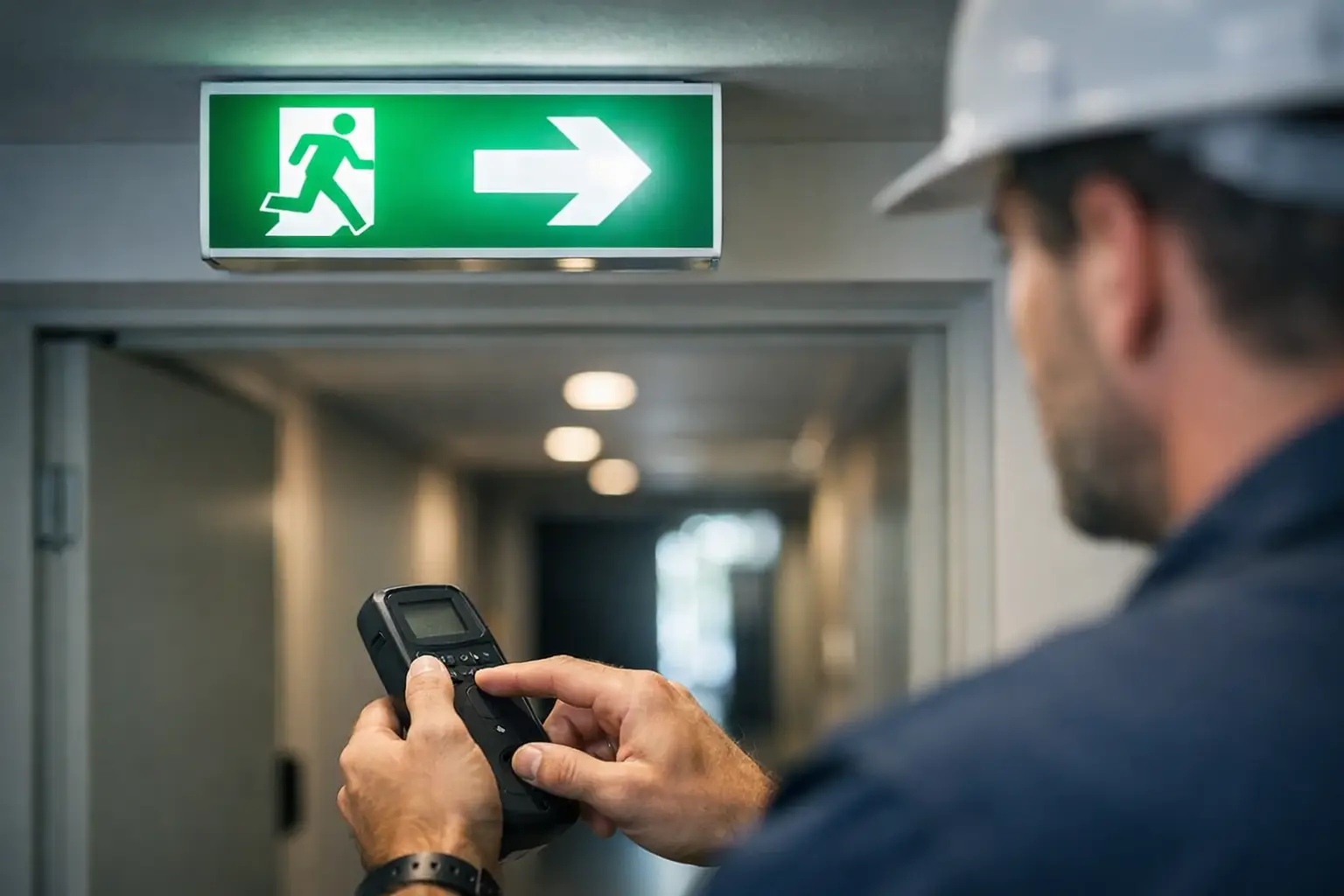
How to Test Emergency Lighting in Your Property
A failed emergency light is easy to miss during a normal walkthrough. It only becomes obvious when the mains supply fails, corridors are dark and people need a safe route out. Knowing how to test emergency lighting gives landlords, managing agents and duty holders a practical way to find faults before they become a safety or compliance issue.
For managed properties, the job is not simply to press a test button and tick a box. Testing must be planned around the building’s use, carried out safely, recorded properly and followed by prompt repairs where faults are found. The right approach protects occupants and gives you a clear record for inspections, audits and handovers.
What emergency lighting testing is checking
Emergency lighting is designed to operate when the normal lighting supply fails. Depending on the property, it may illuminate escape routes, stairwells, corridors, open areas, plant rooms, external escape routes or areas where a task must be made safe before evacuation.
Most fittings have an internal battery that charges while the normal electrical supply is available. During a test, the fitting is made to operate from that battery supply. This confirms more than whether an indicator LED is visible. It checks that the lamp or LED module works, the battery can support it and the fitting has been connected and maintained correctly.
The expected testing routine depends on the type of system, its risk assessment and the manufacturer’s instructions. In many UK properties, this includes a regular short functional test and an annual full-duration discharge test. The required duration is commonly one or three hours, but it must match the system specification for that building.
Before you test emergency lighting
Do not begin by switching off a consumer unit or removing a fuse. A poorly planned test can leave a building without adequate lighting, interrupt equipment or create risk for residents, staff and visitors.
First, identify how the system is tested. Smaller premises often use individual key-operated test switches, usually located near the relevant distribution board or lighting controls. Larger buildings may have a central test facility, automatic self-testing fittings or a monitored addressable system. Each arrangement needs a slightly different process.
Choose a suitable time. For an occupied block, office, shop or communal area, carry out tests when temporary loss of normal lighting will cause the least disruption. Tell relevant occupants or staff in advance, particularly before a long-duration test. If the premises are occupied overnight or have vulnerable residents, consider whether additional temporary lighting or supervision is needed.
You should also have the emergency lighting logbook available before starting. This is where tests, faults, repairs and corrective actions should be recorded. A test without a record can be difficult to demonstrate later, even if the fittings appeared to work.
Monthly functional tests
A monthly test is usually a short functional check. Its purpose is to confirm that emergency fittings illuminate when the normal supply is interrupted, without significantly discharging the batteries.
Where a key switch is provided, use the correct key to operate the emergency lighting test circuit. Normal lighting may go out in the affected area, while emergency fittings should illuminate. Walk the route and check that each fitting operates. Pay particular attention to escape routes, changes in direction, stairs, final exits, fire alarm call points and fire-fighting equipment where emergency illumination may be needed.
Look for fittings that do not light, are noticeably dimmer than others, flicker, have damaged covers or show signs of water ingress. Check maintained fittings too. These remain illuminated during normal use and should stay lit when the mains supply is interrupted.
After the short test, restore the normal supply immediately and confirm that normal lighting returns. Check any charge indicators where fitted. Record the date, area tested, result and any defects in the logbook.
A monthly test should be brief. Leaving lights on battery power for too long can reduce the battery charge available if there is a genuine power failure later that day.
What to do if a light does not operate
Do not treat a failed fitting as a minor snag. Mark its location clearly, record the fault and arrange repair by a competent electrician or emergency lighting contractor. The issue could be a failed battery, lamp or LED driver, charging fault, damaged fitting, loose connection or a wider circuit problem.
If the fault affects an escape route or leaves an area inadequately lit, assess the immediate risk. It may be necessary to provide temporary controls, restrict use of the area or arrange an urgent repair. This is particularly relevant in communal residential buildings, workplaces and commercial premises that are open to the public.
Annual full-duration testing
The annual test is more demanding because it verifies whether emergency lighting can operate for its full rated duration. For example, a three-hour system should remain illuminated for three hours on battery power.
Plan this test carefully. Batteries will need time to recharge afterwards, often up to 24 hours, and the property may have reduced emergency-lighting protection during that period. Testing at a time when the premises can be monitored and disruption is limited is sensible.
Operate the test system and leave the emergency fittings running for their specified duration. It is good practice to inspect the lights at the end of the period, not only at the start. A fitting that illuminates initially but fades or fails after an hour has not passed a three-hour test.
Once the full duration has elapsed, restore the mains supply and check that charging resumes. Record the test duration, all areas checked, defects found and the action taken. Where a fitting fails, it should be repaired and retested once the battery has recharged.
Some automatic self-test systems carry out routine tests without manual intervention and may report failures through indicators, a panel or building management software. They still need regular review. Someone must investigate reported defects, maintain records and make sure the programmed test schedule matches the property’s requirements.
Keeping an emergency lighting logbook
A clear logbook is one of the most useful parts of the maintenance process. It gives a landlord, facilities manager or responsible person evidence that testing has been carried out and defects have not been ignored.
For each entry, include the date and time, the type and duration of test, the area or fittings checked, the result, any faults identified and details of repairs or follow-up work. Record the name of the person carrying out the test as well.
Keep installation certificates, commissioning records, inspection reports and alteration details with the logbook where possible. This is especially helpful when a property changes hands, a managing agent takes over, a fire risk assessment is reviewed or an inspection is due.
When to bring in a competent contractor
Routine monthly checks can often be completed by a trained responsible person who understands the building and the testing arrangement. Annual tests, fault diagnosis, battery replacement, alterations and certification work are different. These should be handled by a competent contractor with the right electrical knowledge and equipment.
Professional support is also worthwhile where a property has mixed-use areas, several distribution boards, poorly labelled circuits, central battery systems or recurring failures. Replacing a battery may appear straightforward, but using the wrong type or capacity can leave a fitting unable to meet its intended duration.
Emergency lighting should also be reviewed after refurbishment, layout changes, a change of use or alterations to escape routes. A new partition wall, relocated exit or converted storage area can affect whether people can see their way out safely. Testing confirms that existing fittings work; it does not prove that the design still provides suitable coverage.
Common mistakes that cause problems
The most common issue is testing only the fittings that are easy to see. Emergency lights in cupboards, rear corridors, external paths, bin-store routes and stairwells can be overlooked, despite being critical in an evacuation.
Another is carrying out a full-duration test without warning occupants or considering recharge time. A final mistake is recording “passed” when faults have been spotted but not resolved. A useful record should show the complete journey from test to repair and retest.
For landlords and property managers, emergency lighting is one of those systems that needs attention before it is needed. A planned test schedule, accurate records and quick action on faults help keep buildings safer, more compliant and ready for the people who rely on them.




No Comments