
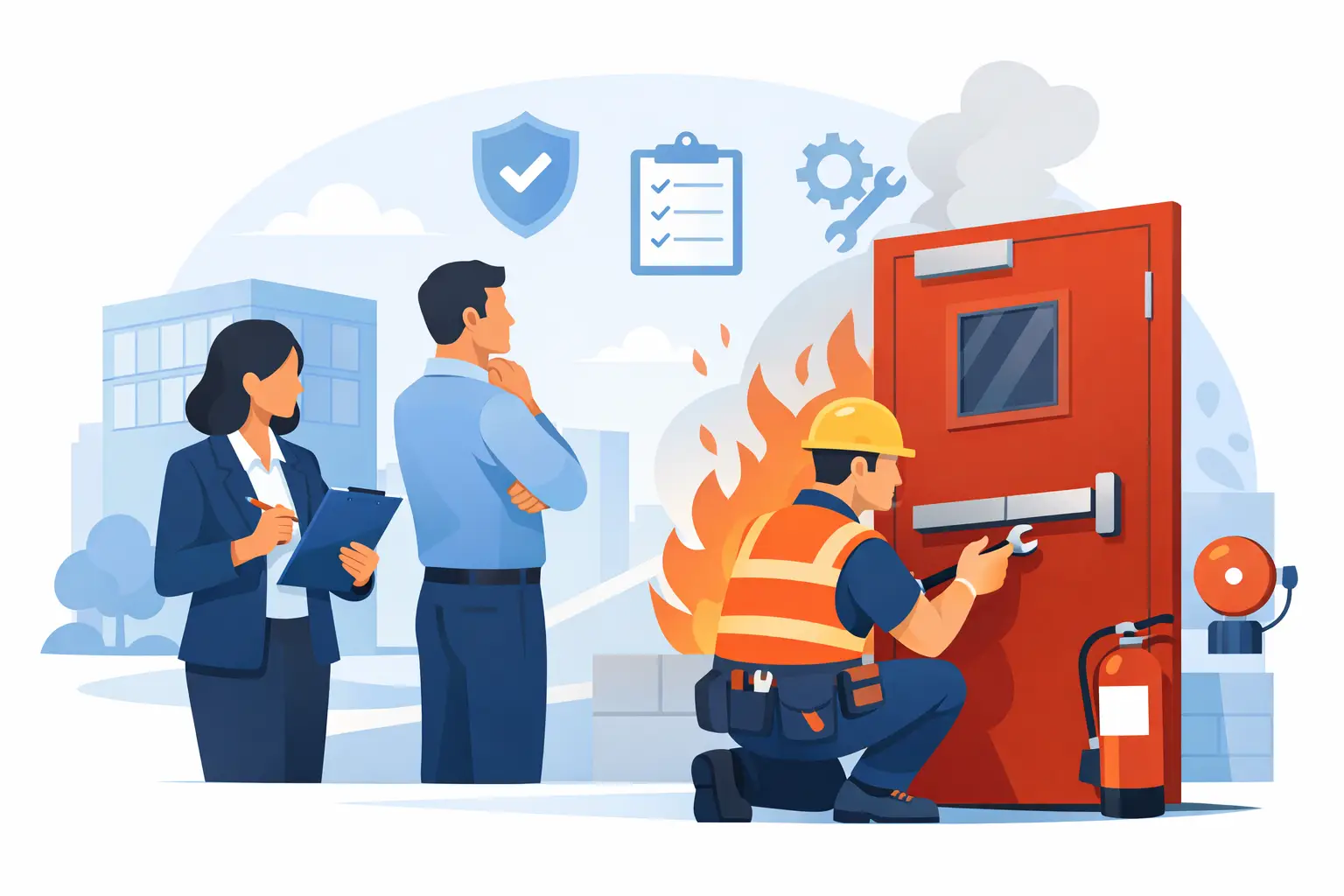
Who Is Responsible for Fire Door Maintenance?
A fire door that does not close, latch or seal properly can allow smoke and fire to spread far faster than intended. That is why the question of who is responsible for fire door maintenance is not simply a matter of arranging a repair. For landlords, managing agents, employers and building owners in East Sussex, it is a key part of keeping people safe and meeting fire safety duties.
The short answer is that responsibility normally sits with the person or organisation that has control of the premises. In many buildings, however, the practical work is shared between an owner, landlord, managing agent, tenant and maintenance contractor. Clear responsibilities, proper records and prompt repairs prevent important fire safety work from being missed.
Who is responsible for fire door maintenance in the UK?
In England, the Regulatory Reform (Fire Safety) Order 2005 places duties on the building’s “Responsible Person”. This is usually the employer in a workplace, or the person who owns, manages or controls a building or its shared areas.
For a block of flats, the Responsible Person may be the freeholder, a management company, a housing association or a managing agent acting on their behalf. For a commercial unit, it may be the employer or business tenant, particularly where they control the premises. In a mixed-use building, there can be more than one Responsible Person, each with duties for the areas they control.
A managing agent or contractor can organise inspections and maintenance, but the legal duty cannot simply be passed away. The person with responsibility must make sure the work is planned, completed by competent people, recorded and acted on when faults are found.
Responsibility depends on the type of property
Landlords and owners of rented homes
A landlord’s responsibilities differ depending on whether the property is a single dwelling, a house in multiple occupation or part of a block with communal areas. The Fire Safety Order generally applies to common parts of residential buildings, such as corridors, stairwells, plant rooms and shared entrances, rather than the inside of an individual flat.
Where fire doors protect these common routes, the person responsible for the building must maintain them. This includes communal doors, riser cupboard doors and doors between shared areas and protected escape routes. The landlord or freeholder may also have obligations for flat entrance doors where they form part of the building’s fire strategy.
A tenancy agreement may require a tenant to report damage or avoid altering a door, but it does not remove the landlord’s wider safety duties. If a tenant reports a broken closer, damaged intumescent strip or door that will not latch, it should be treated as a fire safety issue rather than an ordinary joinery repair.
Managing agents and block managers
Managing agents are often the practical point of contact for fire door maintenance in managed blocks. They may arrange inspections, obtain quotations, instruct contractors and keep compliance records for the freeholder or residents’ management company.
Their role needs to be defined clearly. If the agent is acting for the Responsible Person, they should have a documented process for reporting defects, authorising repairs and escalating urgent issues. Relying on residents to mention problems during routine visits is not enough, particularly in busy communal buildings where a defective door can go unnoticed.
For buildings containing two or more domestic premises, the Fire Safety (England) Regulations 2022 require Responsible Persons to use their best endeavours to check flat entrance fire doors at least every 12 months. Communal fire doors must be checked at least every three months. These are minimum legal frequencies, not a reason to ignore defects reported between inspections.
Employers and commercial tenants
In offices, shops, warehouses, workshops and other workplaces, the employer is commonly the Responsible Person. If a business tenant controls a unit, it will often be responsible for the fire doors within its occupied space, including doors protecting escape routes, kitchens, storage rooms and plant areas.
The lease is still important. It may state whether the landlord maintains the structure, external doors, common parts or particular fire safety systems. But a lease arrangement does not allow a business to leave a known fire door defect unresolved where employees, visitors or contractors may be at risk.
In multi-let commercial premises, the landlord may be responsible for shared corridors and staircases while each tenant is responsible for its own unit. Both parties need to co-operate, share relevant fire safety information and make sure one side’s work does not undermine the other side’s arrangements.
Residents and leaseholders
Residents are not usually responsible for the formal inspection and maintenance programme in common areas. They do, however, have an important role in day-to-day fire safety. They should not wedge open self-closing fire doors, remove seals, fit unsuitable locks or make unauthorised alterations to flat entrance doors.
Leaseholders can have repair obligations under their lease, particularly for a door serving only their flat. In practice, any proposed replacement or alteration should be checked against the building’s fire strategy before work starts. A new door may look suitable, but a fire door only performs as intended when the leaf, frame, hinges, seals, glazing, closer and latch work together as a tested assembly.
What does fire door maintenance involve?
Fire door maintenance is more than checking whether a door looks undamaged. A competent inspection considers whether the door closes fully from any angle, latches securely and has suitable gaps around the frame. It also checks the condition of hinges, closers, handles, glazing, intumescent strips, smoke seals and signage where required.
Damage from everyday use can quickly affect performance. Common faults include loose hinges, missing seals, failed closers, warped door leaves, oversized gaps, holes from removed hardware and doors that have been painted shut or altered without suitable materials.
The right response depends on the defect. A closer adjustment or replacement seal may be a straightforward repair. A severely damaged or incorrectly fitted door may require a like-for-like compliant replacement or a wider assessment of the frame and ironmongery. The cheapest repair is not always the right one if it leaves the door unable to provide the required fire resistance.
Inspection frequency and record keeping
There is no single inspection interval that suits every building. The fire risk assessment, building use, occupancy levels, condition of the doors and manufacturer guidance should inform the maintenance plan. High-traffic doors in a commercial building may need more frequent attention than doors in a quiet residential corridor.
For multi-occupied residential buildings in England, the quarterly and annual checks set out in the Fire Safety (England) Regulations provide a clear baseline for communal and flat entrance doors. Other fire doors should be inspected at intervals appropriate to the risks identified in the fire risk assessment.
Good records should identify each door, its location, rating where known, inspection date, defects found, repairs completed and any outstanding actions. This gives managing agents and owners a clear audit trail and helps contractors understand what has changed since the previous visit. It is particularly useful before an inspection, after a refurbishment project or when responsibility changes hands.
Choosing a competent contractor
Fire doors should be inspected and repaired by people with suitable knowledge, training and experience. A contractor needs to understand that changing one component can affect the performance of the whole door set. For example, fitting an unsuitable closer, lock, letter plate or glazing detail can compromise a door that otherwise appears sound.
Ask how defects will be recorded, how urgent issues will be prioritised and whether repairs will be completed with compatible components. Third-party certification can provide additional reassurance, but the key requirement is competent work, proper evidence and a maintenance approach that reflects the building’s fire risk assessment.
For landlords and property managers, using one dependable maintenance partner can also reduce delays between inspection, quotation and repair. Action Property Group supports fire door repairs, lock changes and wider property maintenance across East Sussex, helping clients keep occupied and vacant properties safe, presentable and ready for handover.
A practical way to avoid gaps in responsibility
The most effective approach is to name the Responsible Person, document who manages each part of the building and make fire door checks part of the regular maintenance schedule. Staff, tenants and residents should know how to report a fault and understand that wedging open a fire door or interfering with a closer is not a minor convenience issue.
If you are unsure where responsibility begins and ends, start with the fire risk assessment, tenancy or lease arrangements and the areas each party controls. Then make sure defects are inspected promptly and repairs are not left until the next planned visit. A fire door only protects people when it is capable of closing properly at the moment it is needed.




No Comments